


Courtroom Bags for Men: Professional Styles that Make a Statement

First Impressions, Seven Seconds – Which Bag Calms Nerves Before You Speak?
Walk into a courthouse lobby, and you’ll feel it instantly – the hush, the fluorescent glare, the hum of security gates.
Everyone is watching something: shoes, posture, bags. First impressions in this space aren’t philosophical; they’re physical (source).
Research says people form judgments in seven seconds. Seven. That’s about the time it takes for a bailiff to glance at you, your client to fidget, and your bag to land in a plastic tray.
- Signal control: Think of your bag as your silent opening statement. A rigid briefcase with defined corners whispers “filed, tabbed, cross-referenced.” A collapsing tote? More “weekend farmer’s market” than Supreme Court.
- Silent handshake: Ever had a zipper glide so smoothly it felt like closing the door of a BMW 7 Series? That’s the tactile reassurance you want. Hinges that creak are like the shoes that squeak in a hushed library – memorable for all the wrong reasons.
- Security choreography: Remember: it’s not you who handles your bag first. It’s a guard sliding it across the belt. If it caves in, spills its contents, or snags, you’ve set the wrong tone before even greeting the clerk.
- Ideal exterior thickness: Leather panels should measure at least 1.6-2.0 mm in thickness to resist collapsing when empty. Nylon should be ≥ 1050 denier to prevent sagging.
Section takeaway – First contact starts at security, not at counsel table; pick a shape that stays dignified even when someone else is manhandling it.
Measure Once – Fit, Capacity, Court Compliance

Think of this as courtroom carpentry: measure once, argue twice. Judges won’t care if you bought Italian leather if the bag doesn’t fit the tray.
- Hard metrics: Courts cap dimensions at 18 × 14 × 8.5 inches (45.7 × 35.5 × 21.6 cm). Show up with something bulkier, and the guard points to a locker with all the warmth of a customs officer.
- Scanners and bins: Those trays? They’re 20 × 15 inches, designed for uniform throughput. Overstuff your bag and it perches like a Thanksgiving turkey on a salad plate – awkward, unstable, and everyone notices.
- Binders + devices reality: Picture a 16-inch laptop (about the width of a Vanity Fair spread), a 2-inch binder thick with exhibits, a 20 oz bottle, and a charger brick that’s the size of a paperback. That’s your daily kit, not the marketing photo’s minimalist load.
- Consequences of misfit: Overpack and you’ll see seams straining within 18 months, zippers gaping by half an inch, and – worst – the courtroom equivalent of rifling through your luggage on stage.
Fit check method: Time yourself: laptop, binder, pen out in under 15 seconds, no rummaging. Fail that? The bag failed you.
Section takeaway – Court rules vary; size to the strictest building you visit in a month, not the most lenient.
Briefcase Materials Under The Spotlight – Leather vs. Nylon
Lighting in courthouses is like an interrogation lamp – harsh, merciless.
What looks refined in your apartment mirror can look greasy under those bulbs (source).
Here are the briefcase specs we recommend:
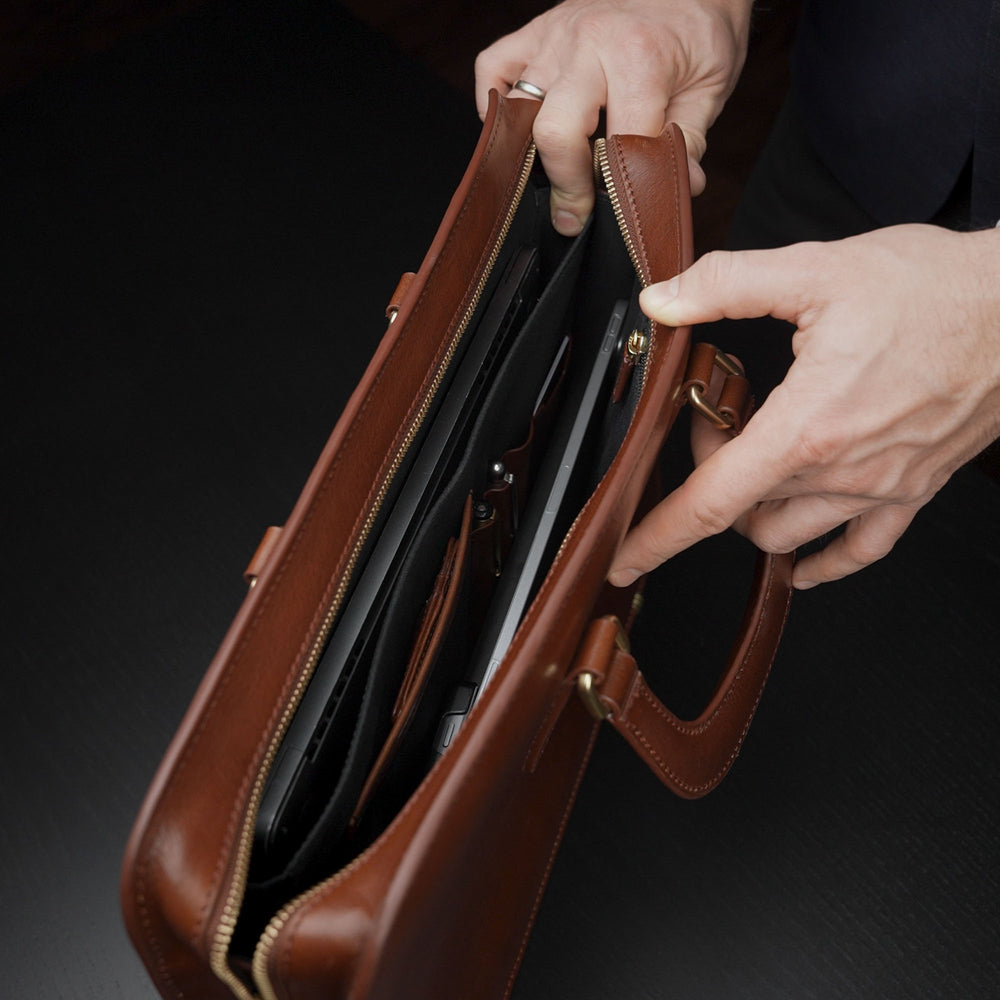
- Full-grain vegetable-tanned leather: Thickness 1.8-2.2 mm, weight 4-5 lb empty. Gains patina like an old Blackstone commentary: worn edges, deeper character. Lifespan 10-15 years with care.
- Where to buy? I found these bags at Von Baer, which meet that spec, full-grain vegetable-tanned leather sourced from Italy, and with solid brass hardware, so they don’t look scratched after a year of use. Should be good for a decade or more.
Other less professional options:
- Top-grain leather: 1.2-1.6 mm, sleeker, about a pound lighter. Easier for daily commutes, but less depth in tone over time.
- Ballistic nylon: Military-born. 1050D = 7.2 oz/sq yd, 1680D = 11.5 oz/sq yd. The higher number laughs at abrasion but adds half a pound. Matte weaves look dignified; shiny ones resemble gym duffels. Not very professional.
- Hybrid builds: Nylon + leather hybrids hover 2.5-3.5 lb empty. A good compromise: resilience with polish. Think “The New Yorker with a waterproof cover.” Again, lacking professionalism, especially for court.
Section takeaway – Match fiber to calendar: presentation days want character; travel days want resilience.
Pick a Form That Earns Nods, Not Eyerolls
Form isn’t vanity; it’s choreography. Every shape has a role, and miscasting your bag is like putting Hamlet in a sitcom.
- Structured briefcase (zip-top): Depth 3.5-4.5 inches. It stands upright like an Oxford don, ready for cross-exam notes. Perfect when you want to channel The Economist rather than GQ.
- Slim attaché (clamshell): A minimalist’s dream, 2.5-3.0 inches deep, but about as roomy as a Penguin Little Black Classic. Bring more than laptop + padfolio? You’ll juggle loose papers like a street performer.
- Messenger with stabilizer strap: Adjustable 38-54 inches; fine for subway commutes. But flap-only? Imagine a bailiff opening it and your pens rolling like dice across marble floors.
- Litigation tote: Height 15-17 inches, built for exhibits. But unless reinforced at 4 mm base, it sags. Sagging in court is not a metaphor you want attached to your name.
- Rolling pilot case: 17-18 wide, 9-10 deep. Great for hauling three binders, bad for jamming into 1920s courthouse elevators clearly designed when everyone carried only a quill.
Section takeaway – Form follows venue traffic: standing bags beat slouching ones in crowded lines.
Hardware & Openings That Don’t Fight Security

You’ve watched someone wrestle a stubborn clasp, right? In court, that’s not just awkward – it’s theatrical.
- Top zipper vs flap-only: Go for zippers #8 or #10 YKK coil teeth. Smooth like turning a fountain pen on Clairefontaine paper.
- Minimal metal load: Keep hardware < 0.5 lb. Clinking buckles echo under marble domes.
- Wide-mouth openings: 12-14 inch clearance lets you slide binders flat. Try sideways and you’ll look like you’re solving a Rubik’s cube.
- Lockable pullers: 2 oz each, TSA-approved. Not for court security, but priceless for Amtrak rides.
Section takeaway – If a stranger can open it, scan it, and close it in five seconds, you chose well.
Layout That Finds Things Without Looking
When adrenaline spikes, your fine motor control dips. Digging for a pen feels like defusing a bomb.
- Three-zone logic: Tech zone (14-16 in laptop with 0.75 in padding), paper zone (8.5 × 14 in docs), quick-grab (≤2 in deep). Each object = one fixed address.
- Standing organizer: Pen slots 0.4-0.5 in wide. Anything looser, pens vanish like socks in laundry.
- Cord control: Charger brick (6 × 2.5 in, cord 6 ft) belongs in a 6 × 4 in pouch. Otherwise, you’re pulling spaghetti in front of opposing counsel.
- Flat bottle sleeve: ≤ 2.8 in diameter. Keeps suit lines smooth – no bulging silhouette like you stuffed a baguette in there.
Section takeaway – Every item gets one parking spot; nothing rides loose.
Ergonomics That Save Shoulders, Suits, and Time

Every lawyer remembers the first week their shoulder throbbed more than their brain. Bad ergonomics broadcast fatigue like a headline.
- Handle spacing: 2-2.5 in clearance keeps rings from scraping. Ever scraped brass knobs on mahogany doors? Same wince.
- Strap width: 1.25-1.5 in padded strap = 25-30% less pressure per square inch. Wider distributes, thinner cuts.
- Drop length: 18-22 in. Too low, and your bag smacks door handles like a clumsy stagehand.
- Weight cap: ≤ 4 lb leather, ≤ 3 lb nylon. Fully loaded: 12-15 lb. You wouldn’t carry a stack of law reviews that heavy every day – why let your bag sneak it in?
Section takeaway – Comfortable carry protects focus for oral argument.
Court-Safe Colors, Finishes, Branding
Courtrooms flatten style like newsprint. Shiny becomes gaudy, subtle becomes silent authority.
- Colors that work: Black (RGB 0,0,0), dark brown (#3B2F2F), navy (#1A1F71). Anything louder risks jurors noticing your bag before your brief.
- Finish: Gloss < 20 GU at 60°. Beyond that, you look like a patent leather shoe ad.
- Branding: Logos ≤ 0.5 in wide. A bold plaque draws eyes like a misplaced footnote in a Harvard Law Review article.
I actually found this article really useful when researching this post.
Section takeaway – Restraint looks intentional when the rest of the room is listening.
Price Bands That Make Sense Over 3-5 Years
Think price-per-hearing, not sticker shock.
- Entry (£/$100-250): Leather 0.9-1.1 mm, nylon <1000D. Lifespan 2-3 years at 3-4 days/week.
- Mid (£/$300-700): Top-grain, stitch count 6-8 per inch, YKK #8/#10 zips. 5-7 year lifespan.
- Premium (£/$800-2500): Full-grain ≥1.8 mm, stitch count 9-10/inch, replaceable hardware. 10-15+ years, like a casebook that never goes out of print.
Section takeaway – Buy once for your common week, rent/borrow for outliers.